

Earthquakes frequently trigger rock falls. Now there’s solid evidence marsquakes can send boulders tumbling, too.
Scientists mined high-resolution imagery of the Red Planet taken shortly after a recent temblor and found hundreds of new imprints left by tumbling boulders, researchers report September 2 in npj Space Exploration. Such rockfalls can be used as a proxy for seismic data, which is difficult to collect across the solar system.
The data were collected with NASA’s InSight lander, which touched down on Mars in 2018. Over the next four years, its seismometer detected more than a thousand marsquakes. Many of those temblors originated in a region known as Cerberus Fossae, just north of the Martian equator. That’s a dynamic landscape riddled with slopes, cracks and rocks on the move, says Vijayan, a planetary scientist at the Physical Research Laboratory in Ahmedabad, India, who goes by a single name. “Thousands and thousands of boulders have fallen.”
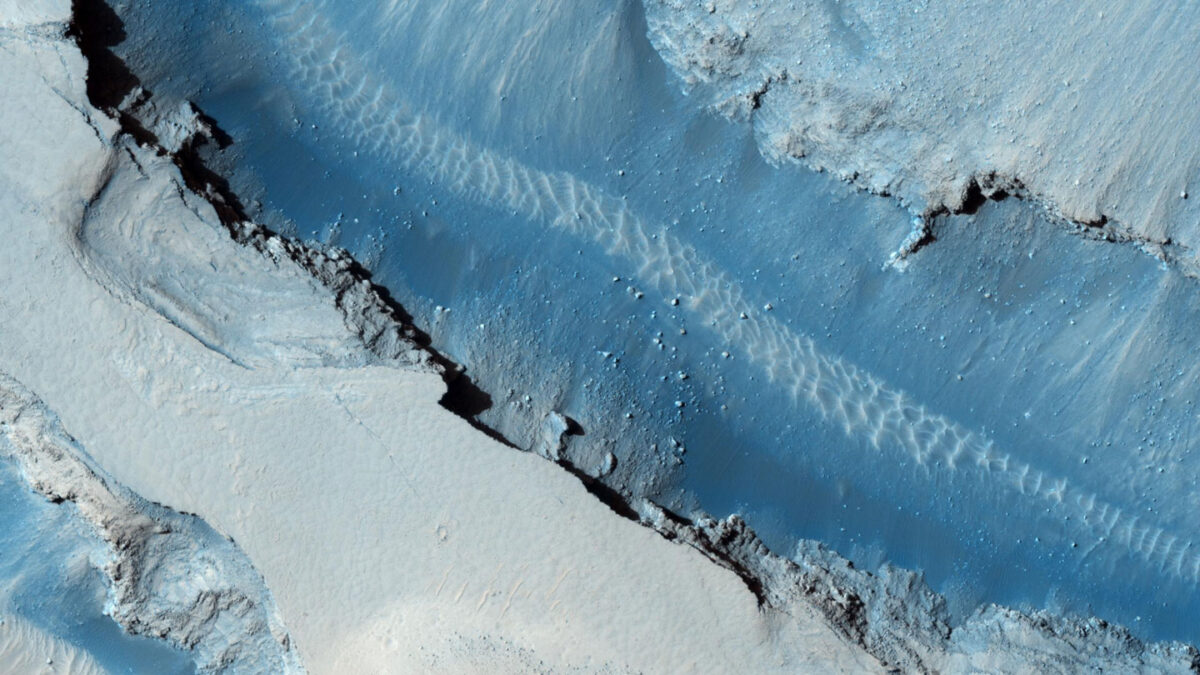
Vijayan and his collaborators focused on one well-detected marsquake captured by InSight that occurred in July 2019 just a few tens of kilometers from Cerberus Fossae. By comparing images taken in June 2019 and December 2020, the researchers discovered 27 new linelike features. Each was composed of tens to hundreds of distinct marks. These structures were most likely tracks created by boulders bouncing downhill, the team concluded.


Using historical imagery, the researchers calculated that only about two such features form each year on average in Cerberus Fossae. “We have statistics of previous boulder falls,” says Bivas Das, a seismologist at the Physical Research Laboratory and a member of the research team. Recording 27 new structures over a span of just 18 months is wholly unexpected, Das says. “That’s a big increase.” The nearby marsquake recorded by InSight was probably the instigator, the team concluded.
Mysteries remain, however. All of the rockfalls occurred on the north side of a prominent valley in Cerberus Fossae, despite more boulders being located on the south side of the valley. “That puzzles us,” Vijayan says. The complex landscape of Cerberus Fossae might well alter how seismic waves travel, making it difficult to predict how shaking will impact different areas, he says. “The wave propagation is going to be complicated.”
Looking for such boulder falls elsewhere could help space exploration efforts, the team suggests. Human settlements would do best avoiding areas that are seismically active, and tumbling boulders can be the proverbial canaries in the coal mine, Vijayan says. “They’re like a proxy in the absence of seismic data.”