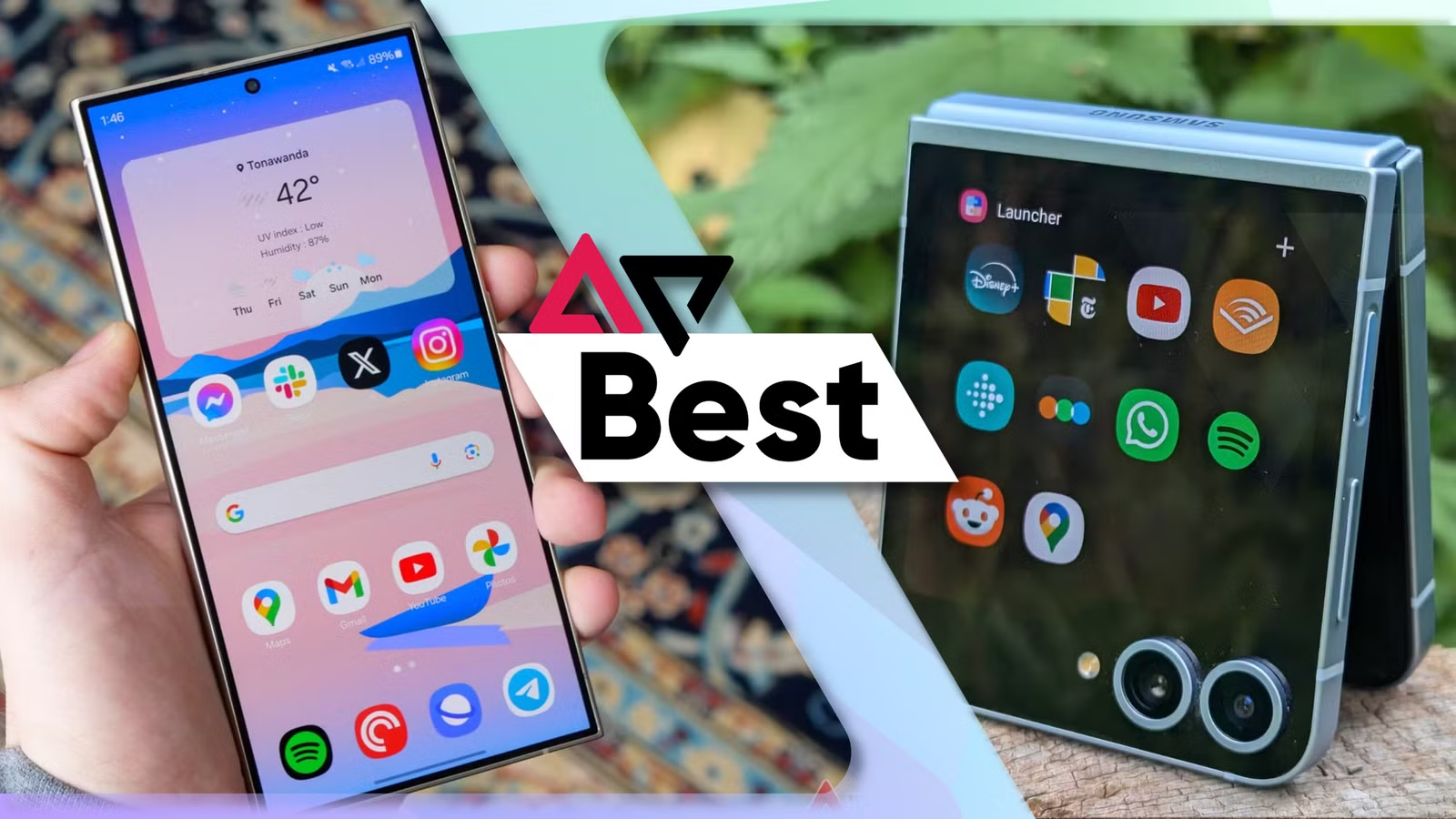


Samsung is considered a juggernaut in the smartphone industry. You can find a range of high-quality phones, from budget to premium, across the A series, S series, FE range, and foldables.
With so many delectable choices, it’s hard to select the right option. But thankfully, we’ve been extensively testing Samsung hardware for years, and we know exactly which models meet the gold standards for a winning Android phone.
As a result, we curated the best Samsung phones for every consumer budget and ensured each product listed delivers the biggest bang for your hard-earned buck.
Samsung’s top Galaxy phones


7.5/10
- SoC
- Qualcomm Snapdragon 8 Elite for Galaxy
- Display type
- 120Hz AMOLED
The Galaxy S25+ represents the peak of functional balance in Samsung’s ecosystem. While the base S25 and S26 models are limited to FHD+ resolution, the S25+ boasts a QHD+ Dynamic AMOLED 2X panel with a higher pixel density (~513 ppi) than even the S26 Ultra. Plus, it is hard to argue with its easy-to-access price point, as it also bypasses the “Ultra” tax by offering nearly identical battery life and 45W charging speeds to the S25 Ultra.
- 7 years of software support
- Faster 45W charging
- A vibrant AMOLED display
- Camera specs are outdated
- Supports only USB 3.2 Gen 1 (5 Gbps)
- No native Qi2 support
The Samsung Galaxy S25+ still feels premium without breaking the bank. The display is 6.7 inches, which is mostly the same as before, but the design remains thinner and lighter than its predecessor.
Other noticeable differences and improvements include faster CPU and GPU performance, thanks to Qualcomm’s Snapdragon 8 Elite chip, which is also housed in the other Galaxy S25 series, including the Ultra and the Edge.
The battery is also fairly good, capable of supporting up to 30 hours of video playback, which is only a little more than the Galaxy S24+ (both use a 4,900mAh lithium-ion battery).
As for software, Samsung continues its long-term update promise with the Galaxy S25 and S26 series, so expect around seven years of OS and security patch support.
The Galaxy AI suite still maintains its presence on the Galaxy S25+, seamlessly integrating into apps and features like Samsung Notes and Samsung Keyboard, as well as productivity areas like Notes Assist and Live Translation.
Plus, with access to the latest One UI version, you can experience other AI-driven features that help you stay caught up in your daily life in a pinch, like the Now Bar, Now Brief, and improved Circle to Search (partnered with Google).

The Galaxy S25+’s cameras are very similar to those of the Galaxy S24+, which we praised previously for being solid.
It features the same 50MP primary camera, 10MP 3X telephoto lens, and 12MP ultrawide. The main improvements come from enhanced AI processing via the ProVisual engine, low-light video shooting, and reduced shutter lag.

The Galaxy S25+ proves the Samsung you love is long gone
Good enough is the new standard
If you were a fan of this lineup’s predecessor screen and battery, you’ll be happy to know that the Galaxy S25+ brought over the same goods. It still has a 1,440p display, capable of reaching 2,600 nits and supporting a variable refresh rate up to 120Hz.
RAM isn’t an issue since Samsung made sure this phone packs at least 12GB of LPDDR5X RAM, which is definitely more than enough to run multiple applications and play games. Plus, the phone has a decent cooling system to keep your hands from scorching while gaming.
Everything is also powered by the Snapdragon 8 Elite chipset, a sizeable upgrade over the previous Gen 3 chip on the Galaxy S24+.
The chip is built around efficiency. Qualcomm has quoted around 44% for the CPU and 40% for the GPU, delivering an overall 30% performance gain, which we’ve definitely noticed that jump while reviewing it.
The NPU component is also better (around 25% faster), which is what’s driving all your AI features that use on-device processing.
So if you’re looking for Qualcomm’s current top-of-the-line chip, this is what you get with the Galaxy 25+. Plus, the chip is in every phone, even if you don’t buy one from the US.
The Galaxy S25+ supports 15W wireless charging and 45W wired USB-C charging. It also supports Qi2 wireless charging standards, but you need a Qi2-certified magnetic case to charge it.
The phone includes Wireless PowerShare, which lets you charge other Qi2-enabled devices (like your Galaxy Watch) by placing them on the back of the phone.
While the reverse charging mechanism is a bit slow, it makes a great emergency backup option to save a dying accessory or two in case you go without a charger for a minute too long.

- SoC
- Qualcomm Snapdragon 8 Elite Gen 5
- Display type
- Dynamic AMOLED 2X
- Display dimensions
- 6.9-inch
- Display resolution
- 3120 x 1440
The Galaxy S26 Ultra remains the definitive choice for power users, distinguishing itself from other flagships with a massive 6.9-inch QHD+ display that now features a world-first Privacy Display to block side-angle viewing. It sets a new standard for mobile photography with its 200MP main sensor and an upgraded 50MP telephoto lens, both of which utilize wider apertures to capture 47% more light for superior low-light performance.
- Privacy Display
- Top-notch Qualcomm Snapdragon chipset
- Improved design
- Lagging behind in dust and water resistance
- Not truly a 10-bit display
If you desire the best of the best that Samsung has to offer and don’t mind paying a pretty penny, you’ll want to get your hands on the Samsung Galaxy S26 Ultra.
Ergonomically, the Galaxy S26 Ultra is already a step up from the Galaxy S25 Ultra. It’s less angular than its predecessor. This helps eliminate the stabby feeling you’d get while holding the phone.
Outside of the subtle Galaxy S26 Ultra design upgrade, the cameras are still great. It’s not a drastic improvement over the Galaxy S25 Ultra, but it is still good.
You’ll quickly notice that it can take better photos in low light, all thanks to upgraded hardware. The Galaxy S26 Ultra has a 200-megapixel main camera with an f/1.4 aperture and a 50MP telephoto with an f/2.9 aperture. But the performance is still on par with the Galaxy S25 Ultra.

When the S20 and S21 Ultra launched, they came with 12GB of RAM. The S22 and S23 Ultra lowered that to 8GB and made you pay for increased storage to get the extra RAM.
Samsung has now reversed that decision, and all new models, including the Galaxy S26 Ultra, have 12 GB of RAM. Though if you buy the 1TB storage model, you’ll get 16GB of RAM.
Also, there are no discrepancies with the chipset. All Galaxy S26 Ultra phones worldwide will use the Snapdragon 8 Elite (Gen 5) chip.
As for battery life, it’s about the same as before, since the phone still houses the same 5,000 mAh battery. What’s improved is the charging.
The Galaxy S26 Ultra uses Super Fast Charging 3.0, which now supports 60W. Though you’ll need to ensure you have the right charger, since Samsung doesn’t include one in the box in the US, you’ll need to buy a separate PD Power Adaptor to achieve those speeds.
Awkwardly, Samsung neglected wireless charging while increasing performance to 25W. The company decided not to include magnets for Qi2 compatibility, but instead, you can use a magnetic case to enable Qi2 charging speeds.

I reviewed the Samsung Galaxy S26 Ultra, and it’s so much better than all the drama
Yes, we address the drama and broken promises, but the phone takes center stage
Compared to the Galaxy S25 Ultra, the Galaxy S26 Ultra’s display is similar but slightly muted (Samsung opted for natural hues).
However, the controversy over the display stems more from the device being advertised as 10-bit, when in reality it is more like 8-bit, with software simulating 10-bit. So you’re not guaranteed to be getting a true 10-bit panel.
Samsung’s new hat trick for the Galaxy S26 Ultra display is actually Privacy Display.
This feature is implemented at the hardware level and dims the screen to make it harder to view at an angle, preventing others from seeing exactly what you’re doing.
Though this is optional, and you can set it per app, it dims the screen significantly and may wash out colors. While it is a nice idea in theory, it doesn’t seem to pan out well in practice.
Last year, the Samsung Galaxy A56 5G was one of our favorite phones. We praised it as a standout among the other Galaxy phones released last year in 2025.
But now we’ve moved on to its successor, the Samsung Galaxy A57 5G, which we’ve been feeling positive about.
The phone is still relatively new, and we are still reviewing it and will update this guide after we’ve released it. So far, everything looks good. The Galaxy A57 5G features a 6.7-inch 120Hz display and has a 50MP camera.
It’s also powered by the Exynos 1680, a step up from the Galaxy A56’s Exynos 1580. The chipset in the Galaxy A56 proved quite solid and competitive with the older Snapdragon 7 Gen 3.
RAM shouldn’t be much of an issue for this midranger, since it starts at 8GB, but you can upgrade to 12GB if you need more.
The Galaxy A57 5G continues Samsung’s commitment to bringing AI capabilities to budget-friendly devices, so you don’t necessarily need to shell out for a more expensive S-series to experience them, barring some limitations.
Right now, the phone has only been released globally on April 10th for $550. Samsung offers a variety of colors and storage options. The base model is 128GB, but you can upgrade to 256GB if you need more.
Plus, the company is offering six years of software updates, and the phone will start on Android 16. You’re basically getting nearly the full flagship experience at a fraction of the price.

- Display type
- Dynamic AMOLED 2X
- SoC
- Exynos 2400 Deca-Core (4nm)
- Display dimensions
- 1080 x 2340
- RAM
- 8GB
Even though this is still last year’s edition, the Samsung Galaxy S25 Fan Edition stands out as a “sweet spot” in the modern Galaxy lineup because it essentially functions as a more affordable clone of the S25+, offering the same expansive 6.7-inch display and a significantly larger 4,900mAh battery compared to the base S25. You essentially get modern-day specs for only a fraction of the price.
- Battery life is solid compared to the base S25
- A beautiful 120Hz AMOLED display
- 7 years of software support
- The Exynos 2400 is worse than the Snapdragon 8 Elite
- Only 8GB of RAM
At first glance, the Samsung Galaxy S25 FE doesn’t seem anything too special, considering that Samsung brought something completely different (the Galaxy S25 Edge) into its Galaxy S25 lineup last year.
Aside from display size, it offers no selling points over the base model Galaxy S25, unless you’re looking for extra savings. However, you can still snag this phone for a good deal, which can make it worth some cutbacks.

Despite the sacrifices that the Galaxy S25 FE makes compared to its premium siblings, it does well for its mid-range price.
The device isn’t as powerful as the base S25. It uses an Exynos 2400 chipset with 8GB RAM, whereas the Galaxy S25 is equipped with the Snapdragon 8 Elite processor and 12GB RAM.
The Galaxy S25 FE does excel in other areas that might matter more if you aren’t pushing your phone to the limits.
For example, the Galaxy S25 FE has a larger 4,900mAh battery and faster 45W charging, which is important if you need an everyday phone that can reliably last through the day under normal use.
As for software, you’ll still get most of the flagship experience with the Galaxy S25 FE.
Samsung’s seven-year update promise still applies. You’ll get seven years for OS and security updates.
And even though the Galaxy S25 FE uses the Exynos 2400, it is still quite capable of handling AI features, like live translation and generative AI photo editing. So you’re not missing out on much if you don’t want to spend up to secure a more premium model.
Power users will likely be able to spot its shortcomings compared to true flagships. We also don’t recommend shelling out the full price for the Fan Edition. But at even a moderate discount, it’s one of the best sub-flagship phones you can buy.

- SoC
- Snapdragon 8 Elite Gen 5
- RAM
- 12GB
- Storage
- 256 or 512 GB
- Battery
- 4,300 mAh
The Samsung Galaxy S26 is considered a well-regarded phone in the current Galaxy lineup because it perfectly balances flagship power with a refined, pocketable design. While larger models offer niche perks like the S-Pen, the S26 delivers a superior ergonomic experience with its 6.3-inch display, making it the most comfortable option for one-handed use.
- New upgraded storage standard (256GB)
- Bigger screen but more lightweight
- Equipped with the Snapdragon 8 Elite Gen 5
- Slow charging
- No improved cameras
Sometimes newer isn’t always better, but in this case, it still is. The Samsung Galaxy S26 proves to be the best small Galaxy phone once again, thanks to Samsung taking a safer, more refined approach with its early flagship.
The Galaxy S26 is everything the Galaxy S25 is but better. Previously, the Galaxy S24 was our favorite small Galaxy phone. Now, the Galaxy S26 has succeeded both the Galaxy S25 and the Galaxy S24.
The Galaxy S26 has a slightly larger display (6.3 inches) and supports up to 2,600 nits.
The main differences are the base storage and weight. The Galaxy S26 is equipped with a Snapdragon 8 Elite Gen 5 chip and 12GB of RAM (international phones use Exynos 2600), while the Galaxy S25 has only the Snapdragon 8 Elite, with no variants.
The Galaxy S26 is surprisingly a little heavier, but only by 5g. You can also buy it in 256GB or 512GB, which is double the Galaxy S25’s starting storage.

Performance is good on the Galaxy S25 thanks to the Snapdragon 8 Elite Gen 5 chip and 12GB of RAM.
Unfortunately, this is not a global chip, as the Galaxy S25 had, so you will still see the Exynos equivalent powering international phones.
RAM is the same as the Galaxy S25, which is more than enough to comfortably multitask, handle AI, and some gaming. The storage upgrade is a welcome change, since 128GB without any expansion slots can fill up fast.

The Samsung Galaxy S25 is a small phone without any big ideas
Still pretty nice, though
Battery life is also fairly decent. The Galaxy S26 has a 4,300mAh battery, which offers a meaningful uplift when combined with the more efficient display and processor.
Sadly, charging is still limited to 25W. If you want faster speeds, you need to upgrade to the Plus/Ultra. It’s not intolerable with a battery this small, but it lags far behind what other OEMs are offering.

- SoC
- Snapdragon 8 Elite
- Display type
- Dynamic AMOLED
- Display dimensions
- 6.5-inch external, 8-inch internal
- RAM
- 12GB or 16GB
The Samsung Galaxy Fold 7 dominates in productivity thanks to its massive 8-inch internal display and enhanced multitasking tools. Crucially, it has finally eliminated the “foldable camera compromise” by adopting the same 200MP main sensor found in the Ultra series, giving you pro-grade photography on a screen that is 20% larger than any traditional slab phone.
- Major camera improvements
- Top-tier performer
- Thinner and lighter than previous models
- Expensive
- Battery life is acceptable, but not spectacular
Samsung offered a sizable upgrade with the Samsung Galaxy Z Fold 7 over the Galaxy Z Fold 6.
The Galaxy Z Fold 7 is noticeably thinner and lighter, without sacrificing the cover display or the main inner screen.
The foldable comes with a 6.5-inch cover and an 8.0-inch main display, both featuring AMOLED panels and a 120Hz refresh rate.
They’re equally great for consuming content, using your favorite apps, and even gaming. But it doesn’t come without sacrifice. Samsung chose not to include S Pen support to improve the build.
At the very least, the changes are still there, the crease is smaller and less noticeable, and the hinge still does a great job of protecting against water and dust, while being more durable (it uses an upgraded Armor Flex).

The camera received a massive upgrade from the Galaxy Z Fold 6. Instead of the 50MP main sensor, the Galaxy Z Fold 7’s main sensor reaches 200MP, significantly improving photo quality in low-light conditions.
That’s a lot better than what we expected since the Galaxy Z Fold 6 took only decent-to-okay photos. The battery life is good but not amazing. It sports a 4,400mAh capacity that will reliably last you through the full day.
The charging speed is where it falls a little short; the Galaxy Z Fold 7 still supports only 25W wired charging and 15W wireless charging. It’s a bit faster than the Galaxy Z Fold 6, but not groundbreakingly so.

The Galaxy Z Fold 7 is the first time I love a Samsung foldable
Not just for enthusiasts anymore
The Galaxy Z Fold 7 is a great foldable for those looking to try the versatile form factor for the first time, but it is still very expensive for what you get.
However, if you’re looking for the best foldable Samsung has to offer, you can’t go wrong with the Galaxy Z Fold 7 — and it’s still an absolute powerhouse for handling the latest Galaxy AI features.

- SoC
- Exynos 2500
- Display type
- Dynamic AMOLED 2x
- Display dimensions
- 6.9-inches
- Display resolution
- 2520 x 1080
The Samsung Galaxy Z Flip 7 is a fantastic choice for those prioritizing style and portability. Unlike its larger siblings, the Z Fold 7 or S26 Ultra, it excels at hands-free content creation thanks to its Flex Mode and sturdy Armor Flexhinge design. The Z Flip 7 also supports 7 years of OS and security upgrades, making it the ideal companion for years to come —plus, you can sometimes find this phone under $1000, which isn’t as steep compared to some other options in the premium Galaxy lineup.
- Great for multitasking
- It is quite compact and durable
- Solid battery
- The Exynos 2500 chip is a bit inconsistent
- Cover screen usage still isn’t great
- Charging speed is relatively slow
If you’re looking to jump on the foldable bandwagon and don’t want to shell out $2,000 for the latest Galaxy Z Fold 7 — not to mention you appreciate a smaller form factor — the Samsung Galaxy Z Flip 7 might be the best device for you.

The new Galaxy Z Flip 7 sports a 6.9-inch main AMOLED display and a 4.1-inch cover AMOLED display.
It’s powered by Samsung’s Exynos 2500 chipset, coupled with 12GB of RAM and up to 512GB of storage.
Thanks to its signature cooling solution, it’s powerful enough to handle all your daily tasks and can even play some demanding games with ease.
The phone also contains Galaxy AI features that promise to make life easier and more fun in many situations. You can easily edit photos, summarize websites and voice recordings, and more.
The phone will also receive seven years of OS and security updates, making it a great, future-proof flip phone for those looking to hold on to it for the long term.

Samsung Galaxy Z Flip 7: Brilliant flip phone fun, but with a catch
I can forgive its downsides, just about
Like the Galaxy Flip 6, the Galaxy Flip 7 features a decent dual-camera setup. It also has a slightly larger battery than last year’s model (around a 7.5% capacity increase). The cameras are solid.
It’ll take decent photos for the most part, in most lighting conditions, but it’s definitely a step up from the Galaxy Flip 6 for color reproduction and low-light performance.
The battery will last a full day on a single charge, but sadly, we haven’t seen any noticeable improvement in charging speeds.
With that said, if you’re happy with the fun form factor, unique features, and small but more refined changes, the Galaxy Flip 7 remains one of our favorite foldable flip phones.

- SoC
- Samsung Exynos 1330
- Display type
- AMOLED
- Display dimensions
- 6.7 inches
- RAM
- 4GB
The Samsung Galaxy A17 5G is a complete steal at under $200. While it isn’t an absolute powerhouse, it still does a good job of disguising itself as being much better than what you’d expect to get at that price range. This budget bargain offers a vibrant 6.7-inch Super AMOLED display with a smooth 90Hz refresh rate, along with 6 years of software upgrades for ensured longevity. So those looking for a cheap, reliable option will want to keep an eye on the A17 while it’s still in stock.
- Expandable storage
- Six years of software support
- Beautiful display
- 4GB of RAM is too low
- Outdated processor
As long as you keep your expectations in check, the Samsung Galaxy A17 5G absolutely lives up to its potentially sub-$200 price.
You won’t find many others this cheap with a 90Hz, FHD+, 800-nit screen that actually works okay. But this time, Samsung’s Exynos 1330 powers it, which is more than enough to handle everyday use.

Even the cameras are considerably better than we’d expect at this price point, thanks mainly to the 50MP primary sensor.
But it isn’t going to match anything flagship, since this is still a $200 phone.
Outside of some corners being cut, the Galaxy A17 has everything a basic phone user needs.
That includes microSD expansion, a large battery, efficient hardware, NFC connectivity, and even sub-6GHz (including C-Band) 5G support. It is limited to 25W charging, but so are most Samsung phones.
If you plan to do anything beyond basic tasks on your phone, steer well clear of the Galaxy A17.
But if you need a reliable device with a straightforward interface and long, reliable lifespan, at an impressively low price, it’s hard to pass up.
Amazingly, it’s even slated to receive six OS and security patches, so you’ll continue to get updates through Android 21.
Despite the middling SoC performance and the minuscule RAM choice, it’s a capable way for budget-conscious users to stay connected.
Why do people like Galaxy phones so much?
Samsung isn’t the leading Android manufacturer just because of its marketing. There are quite a few objective and subjective reasons why it sells more phones every year than any company not named after a fruit.
- Reliable hardware and build quality: As the industry leader, Samsung has the resources to ensure its quality assurance is top-notch.
- The One UI Android interface: This is a subjective one, but Samsung’s software implementation gets high marks from longtime experts and consumers of all kinds for its intuitive layout, extensive feature set, and high degree of customizability.
- Versatile multitasking features: Among the productivity-focused tools within One UI is Samsung DeX, which essentially turns your phone into a tiny, ARM-powered desktop PC when you connect the right peripherals.
- Samsung Smart Tags: Given Galaxy phones’ popularity, Samsung’s relatively upstart Bluetooth tracker network shows more promise than any other in the Android space.
- AI features, and the future: Love or hate the marketing and terminology, what we call “AI” today enables a wide and expanding range of novel features that range from convenient and nice-to-have all the way to borderline mind-blowing (or creepy, to some).
- Long-term software support: Galaxy S series devices (tablets included) now receive seven years of Android OS and security updates, while A series phones get four to six years, respectively; nobody but Google competes at the moment.
The best Samsung phone for you
If you are looking for the best of the best, the Galaxy S25+ and Galaxy S26 Ultra are our top recommendations from our current series list.
The Galaxy S25+ is a great all-around flagship without breaking the bank.
The Galaxy S26 Ultra continues to live up to its premium expectations. It still offers fantastic S Pen support, a 200MP primary camera, and a 50MP 5X telephoto, though it’s hard to justify the price difference over other options unless you’re an avid S Pen user.
Both phones have some of the best displays you’ll see, offer seven years of OS updates, and immaculate build quality.
If you want something more exotic and unique, the Galaxy Z Fold 7 and Flip 7 are solid contenders. The Galaxy Fold 7 isn’t just a standard smartphone; it can unfold into a decent-sized tablet.
It remains one of the best foldable flagships for reliability, support, and a sturdy design that delivers an excellent overall experience; it might not necessarily be in your budget.
The Galaxy Flip 7 manages to feel like a normal phone when open, which is no mean feat given that it folds in half.
Despite the press Samsung’s top-tier devices get, its midrange and entry-level offerings are genuinely better than ever.
And so far, based on early impressions, the Galaxy A57 delivers, quite frankly, a better experience than you’d expect from an A-series.
Even the A17 is more than passable, as long as you know what you’re in for. Then there’s the Galaxy S25 FE, always a safe option if you want a good go-between.
المصدر الأصلي: www.androidpolice.com